
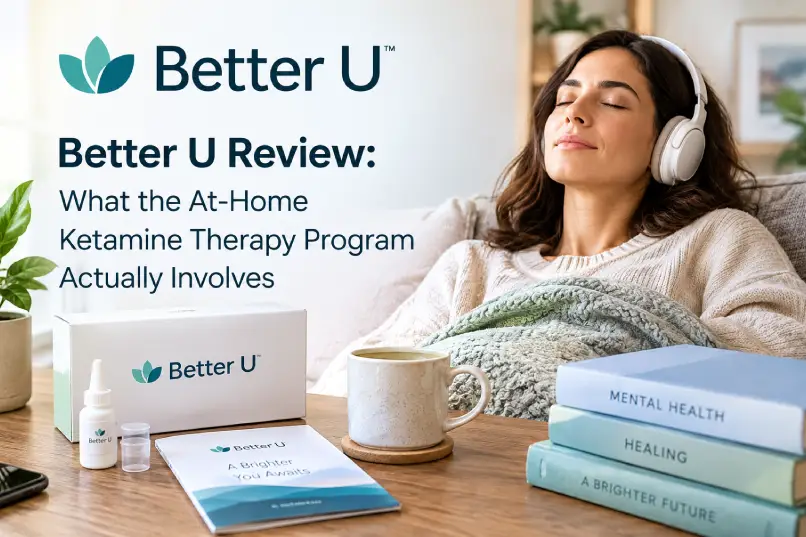
Better U is a telehealth company connecting patients with independently owned medical practices that offer at-home ketamine therapy, alongside a broader menu of mental wellness and longevity services. It’s a more serious purchase than most of what we cover, this is a medical program involving a controlled substance, run through licensed clinicians rather than a product you simply add to a cart. We went through exactly how the program works, what it costs, and importantly, what’s backed by real evidence versus what’s self-reported marketing. This article is informational only and isn’t medical advice; anyone considering this kind of treatment should talk to a licensed doctor first.
The process runs in a fairly structured sequence. It starts with a free online assessment to check basic eligibility, followed by a virtual consultation with a clinician who builds a personalized plan if you qualify. From there, the prescribed medication, oral ketamine lozenges, ships to your home. Before the first session, a Certified Integration Guide walks you through preparation, and the sessions themselves are self-administered at home following protocols laid out in Better U’s member portal. Afterward, integration coaching sessions are meant to help translate whatever came up during a session into daily life, with ongoing messaging access to a care team between appointments. New members also receive a “Brain Box” starter kit, a blood pressure cuff, a meditation mask, glasses, and a journal.
Package | Sessions | Total Price | Per Session |
Introduction | 5 sessions | $500 | $100 |
Transformation | 9 sessions | $792 | $88 |
Introduction (3-month) | 15 sessions + 3 integrations | $1,350 | $90 |
Transformation (3-month) | 27 sessions + 6 integrations | $2,076 | $76 |
Package | Sessions | Total Price | Per Session |
Introduction | 5 sessions | $500 | $100 |
Transformation | 9 sessions | $792 | $88 |
Introduction (3-month) | 15 sessions + 3 integrations | $1,350 | $90 |
Transformation (3-month) | 27 sessions + 6 integrations | $2,076 | $76 |
Split-pay financing is available starting around $45 to $82 per month depending on the package, with some options running through third-party financing. Insurance doesn’t currently cover the program. For context on where this sits in the broader market, Better U’s own materials compare it to in-clinic IV ketamine treatment, which commonly runs $3,000 to $5,000 for a single month, so the at-home oral model is positioned as the lower-cost route into this type of therapy.
This is the part worth reading slowly before signing up for anything. Ketamine therapy for psychiatric conditions like depression, anxiety, OCD, or PTSD is considered off-label use, meaning it isn’t FDA-approved specifically for treating these conditions, even though it’s legally prescribed for this purpose by licensed clinicians. Better U reports that 84% of patients experienced reduced anxiety immediately after their first session, climbing to 92% at the one-month mark, with similar figures for depression (81% immediately, 89% at one month). Those numbers come from internal, self-reported PHQ-9 and GAD-7 symptom tracking, not an independent, peer-reviewed clinical trial of Better U’s specific program. The company itself states plainly that benefits aren’t guaranteed and results vary by individual, which is the kind of disclosure worth taking seriously rather than skimming past.

Ketamine therapy is the flagship offering, but it’s not the only thing on the menu. Better U also connects patients with holistic psychiatry support for tapering off psychiatric medications, licensed talk therapy covering approaches like CBT, DBT, and EMDR, longevity and regenerative treatments (glutathione, NAD+, peptides), sexual health medication, and a weight-loss program built around semaglutide. A companion app rounds things out with guided meditations and mood tracking. It’s a wide net for a single platform, and worth knowing that it functions more as a connector to affiliated practices than as a single clinic delivering every service itself.
This kind of program tends to make the most sense for adults who’ve already tried more conventional treatment routes for depression, anxiety, or similar conditions and are exploring alternatives under medical supervision, rather than someone looking for a first-line treatment or an emergency option. It’s a program to approach alongside your own doctor’s input, not instead of it, particularly for anyone currently on psychiatric medication. If you’re in crisis or thinking about harming yourself, this isn’t the right resource, call or text 988 (the Suicide & Crisis Lifeline) or go to your nearest emergency room instead.

It connects patients with independently owned, licensed medical practices, and the program includes a clinician-led eligibility assessment rather than open self-prescribing. That said, any at-home use of a controlled substance carries real risk, and it’s worth discussing with your own doctor before starting, especially if you’re on other medications.
Not specifically. Ketamine itself is FDA-approved as an anesthetic; its use for psychiatric conditions like depression, anxiety, OCD, or PTSD is considered off-label, meaning it’s legally prescribed for this purpose but hasn’t gone through FDA approval specifically for these uses.
No, the program isn’t currently covered by insurance. Better U offers split-pay financing starting around $45 to $82 a month depending on the package, with some plans running through third-party financing.
Better U positions its at-home oral program as substantially cheaper than in-clinic IV ketamine therapy, which commonly runs $3,000 to $5,000 for a single month of treatment, versus Better U’s packages ranging from $500 to roughly $2,076.
Better U is a legitimate telehealth platform built around licensed clinicians and real medical oversight, and its pricing undercuts traditional in-clinic ketamine therapy by a wide margin. The honest caveat is that its headline results come from the company’s own self-reported data, not independent clinical research, and that distinction matters when you’re weighing a program built around a controlled substance. Anyone considering it should treat this article as a starting point for research, not a substitute for a conversation with their own doctor. For a lower-stakes approach to better sleep and recovery, our Eight Sleep Pod 6 review covers a very different kind of wellness investment.